A First Public Reading in a Borrowed Room
Plan a first public script reading in a borrowed room, with seating, a clear opening and a focused conversation that helps the group hear the work.
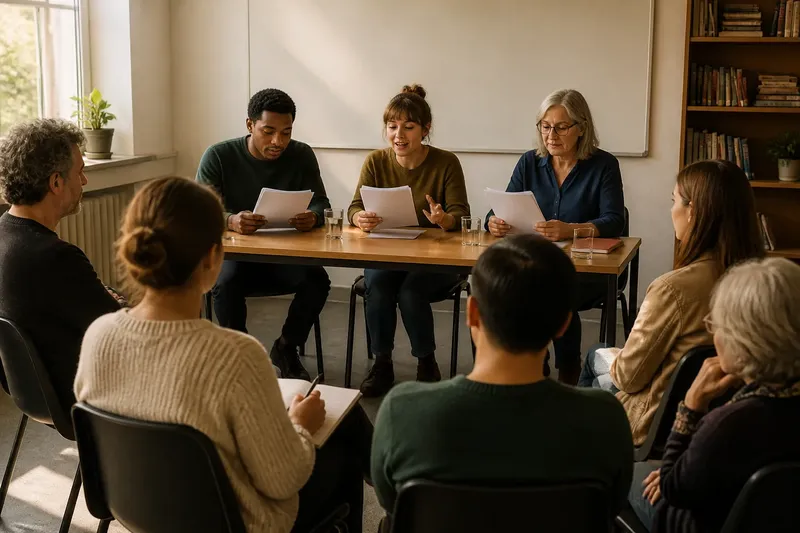
The chairs scrape across the floor as the caretaker unlocks the borrowed classroom, and the script-reading group has a short window to make the room feel welcoming. A first public script reading does not need a stage or elaborate production; it needs a clear way for listeners to gather their attention, hear the text and respond usefully.
Think of the event as a shared encounter with an unfinished play, not a miniature opening night. A modest plan can help everyone understand what they are being invited to do, from the first welcome to the last question.
How should you arrange seats in a borrowed room?
Arrange chairs so listeners can see the readers and one another without creating a formal barrier between performers and audience. A shallow arc or open horseshoe often works well in a classroom, meeting room or community hall. Leave a generous gap for anyone who needs an accessible route, and keep the door and exits clear.
Before placing every chair, stand where the audience will sit and check whether the readers’ faces are visible. If the room has fixed tables, use them as a boundary rather than trying to shift heavy furniture. A few chairs in a compact group can feel more attentive than rows stretched across a cavernous space.
Choose where the script will be read aloud. A table can give actors somewhere to rest pages and water, but it should not hide their faces. If the room is echoey, bring readers closer together and ask them to speak towards the listeners rather than towards a wall. A quiet corner may be preferable to the grandest-looking spot.
Keep the audience’s arrival in mind. Put a simple sign near the entrance if visitors might mistake the room for another meeting, and ask someone to greet them while the readers settle. These small gestures help late arrivals find a seat without interrupting the opening.
What should you tell the audience before the reading?
Give listeners a concise welcome that explains what they are about to hear and how complete the script is. Say whether the reading is a draft, whether actors may pause to turn pages, and whether there will be a conversation afterwards. This prevents an unfinished scene or a stumble over a name from being mistaken for a polished performance choice.
Tell the group what kind of response will be useful. If the writer wants to know whether the relationships are clear, say so. If the main question is whether the final scene feels earned, direct attention there. A specific invitation gives listeners a way into the work without asking them to solve every aspect of it.
Keep practical information brief: where people can sit, whether they may take notes and how the discussion will be handled. Avoid a long introduction to the plot or the writer’s intentions. The script should have room to make its own impression.
How do you choose a clear beginning?
Begin with a short welcome, name the play and its readers, then offer one sentence about the kind of listening you are inviting. For instance: “We’re sharing a draft, so listen for the moments when the characters’ needs become clear.” Then let the first reader begin. A clean opening is easier to follow than a string of apologies, explanations and last-minute announcements.
Agree the opening in advance with the readers. Decide who introduces the event, who names the characters if that helps, and how the first line will start. If the script includes a cast list or stage directions, establish whether these will be read aloud; consistency matters more than theatrical flourish.
Say how the reading will end, too. The final line can be followed by a brief pause before applause or conversation, giving the audience a moment to register the scene. If the piece is a short extract rather than a complete play, make that clear before it starts and indicate where the excerpt stops.
How can readers make the script easy to follow?
Readers should speak at a pace that lets listeners absorb unfamiliar names, shifts in place and changes in who is speaking. They do not need to perform every movement or emotion. A light distinction between characters, clear diction and attention to the punctuation usually give the words enough shape.
Prepare pages so readers can find their place without rustling through loose sheets. Use legible print, clear page numbers and character names that stand out from the dialogue. Mark any pronunciation that could cause hesitation, and agree how to handle a missed line: pause, recover and continue rather than turning a small slip into a scene of its own.
For an invented example, imagine a community group reading a draft in a school library, with three actors sharing a script that moves between a kitchen and a bus stop. They agree to announce each location change plainly, keep the pages in order and pause briefly after the final line; listeners can then follow the shifts without needing scenery or extra explanation.
Water, a pencil and a copy of the running order may help. A stack of decorative props, costume changes or recorded sound is unlikely to improve a first reading unless the text genuinely depends on a particular cue. A borrowed room is not a problem to disguise; it is simply the space the words have today.
How do you keep the conversation focused?
Leave enough time after the reading for listeners to respond while the experience is fresh. Invite observations about what they understood, where their attention sharpened and which relationships or choices they wanted to follow. One person can facilitate, making space for quieter voices and steering comments back to the agreed question.
Ask open questions that point towards the script rather than the writer’s character. “What did you understand about the sisters’ disagreement?” is more useful than “Did you like it?” Encourage listeners to describe a moment and its effect before offering a suggestion. That distinction helps the writer hear what is already reaching the room and where the meaning may be unclear.
It is not worth trying to discuss every scene or collect a verdict on every line. A focused conversation can centre on a small number of questions, with a note-taker recording recurring observations and the writer deciding later what to use. Avoid turning the room into a debate about the one correct interpretation.
What questions should you settle before inviting people?
Should the reading be open to the public?
Invite the audience size the room can comfortably hold, and describe the event plainly so people know they are attending a script reading rather than a fully staged play. A small group can still provide varied responses, especially if listeners are told what sort of feedback would help.
Do actors need to memorise their lines?
No; a reading is designed to make the text audible, and scripts in hand are entirely appropriate. Readers should be familiar enough with the pages to keep their attention on the scene, while remaining free to correct a slip and carry on.
Should the writer answer every comment?
The writer can listen without responding immediately, which gives comments room to stand on their own. A facilitator can remind the group that the purpose is to help the writer notice how the script landed, not to negotiate revisions in the room.
What if the room is noisy or echoey?
Choose the quietest available corner, close doors if the venue permits, and bring listeners closer to the readers. Ask everyone to silence phones and avoid side conversations; if speech remains difficult to hear, adjust the seating before the reading begins.
How should you close the gathering?
Thank the readers, listeners and venue host, then explain what happens next if there is a next step. You might invite written comments by an agreed route or simply let people know that the group will reflect before making changes. Do not promise that every suggestion will be adopted.
Leave time for informal conversation, but make the official ending unmistakable so people can leave without wondering whether another discussion is about to begin. Return chairs and clear the room as the venue requires. A thoughtful close respects both the audience’s attention and the people who lent you the space.
For a first public script reading, the most useful preparation is often modest: arrange the room for shared attention, tell listeners how to listen, and protect time for a purposeful exchange. The next draft can then grow from what the group genuinely heard, rather than from the pressure to make one borrowed room look like a theatre.