Painted Drops and Projection: Choosing a Stage Backdrop
Compare painted drops and projected stage backdrops to choose a clear, workable setting that frames actors without distracting the audience.
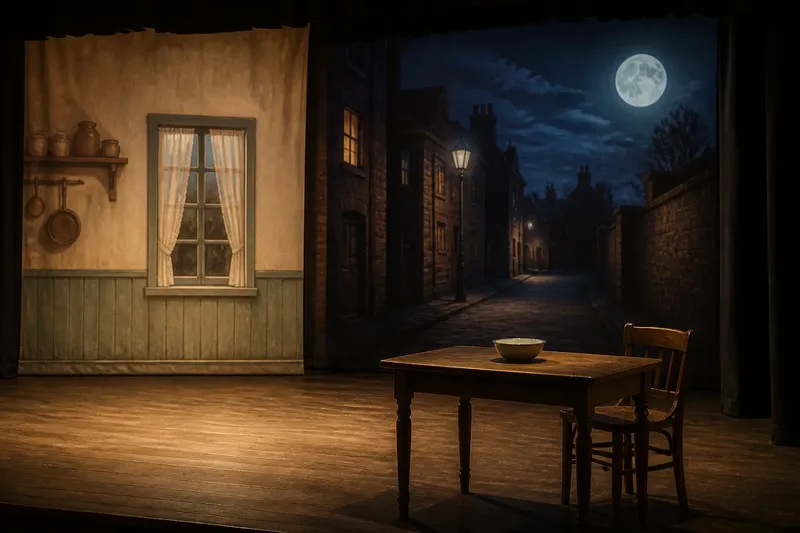
A painted street hangs behind the actors while a projected moon waits for the next scene. For a small theatre group choosing a stage backdrop, the useful question is not which looks more impressive, but which helps the audience read the action without stealing its focus.
What does a painted drop do well?
A painted drop is a large cloth with an image made directly on its surface. A street, landscape or interior can be suggested with colour, perspective and a few defining details. The audience sees a picture of a place, while performers occupy the space in front of it.
That arrangement gives the stage a steady visual world. A painted arch may imply a doorway without building one; a receding road can suggest depth on a shallow platform. The drop stays put through the scene, so actors, movement and speech can remain the main event.
Its fixed quality is also a limitation. A painted image offers one view, and perspective may read differently from seats at the sides. Close detail can look flat, and changing the location may call for another cloth, a reveal or a lighting change. These are not defects if the production treats the image as a theatrical suggestion rather than a realistic wall.
What does projection change?
Projection casts an image onto a screen, wall or suitable cloth. A still picture can establish a location; a sequence can signal a change in time, weather or mood. The image can be replaced without moving a large scenic piece, which can help a production that visits several places.
But a moving or bright image can tug attention away from actors. A detailed photograph may make the stage feel crowded, while a simple outline or colour field can provide atmosphere with less visual noise. Projection is light on a surface, not a physical doorway or window: if an actor must pass through one, the staging needs a real frame or another clear convention.
The room matters. Ambient light, projector placement and the receiving surface affect how clearly the audience sees the image. Projection can fade or change quickly, but each change still needs a cue and a reason. A painted drop offers a stable image; projection offers a changeable one, with more dependence on the venue and equipment.
Which stage backdrop suits your production?
Begin with what the audience needs to understand, then consider the stage and the group’s practical resources. A painted drop may suit one lasting location and a handmade visual style. Projection may suit several quick changes or an image-led atmosphere, if the room can support a legible picture.
- Check the story’s geography. If the audience must recognise a specific place, choose an image with clear landmarks; if mood matters more than location, use a restrained suggestion instead.
- Check sightlines from the seats. If a painted perspective or projected image reads clearly across the room, keep it; if it distorts or disappears from the sides, simplify the design or change its placement.
- Check the actors’ positions against the image. If bright marks or strong lines sit behind faces and bodies, move or soften them; if the performers remain easy to read, retain the composition.
- Check the venue’s hanging options. If an approved, secure hanging point and suitable cloth are available, a drop may be workable; if not, choose a permitted freestanding surface or consider projection on an appropriate wall.
- Check the room’s light and projection surface. If the projected image remains distinct under the show’s lighting, use it; if it washes out or looks uneven, reduce ambient light where appropriate, change the surface or choose a painted image.
- Check how the scene changes. If a new image clarifies a genuine shift of place or mood, give it a cue; if the change adds no meaning, leave the backdrop still or use a simpler transition.
Say a community group has a plain rear wall, a modest projector and a table that stays onstage for a short play moving from a kitchen to a night-time lane. The group first lists what must change: the location and the mood, but not the furniture. It chooses a simple window outline for the kitchen and a restrained moonlit shape for the lane, then places each image away from the actors’ faces and gives the change a clear cue. The expected result is a readable shift of place while the table anchors both scenes; if the projection proves visually dominant from the seats, the group can remove detail or keep the wall plain.
How can a stage backdrop support actors?
Think of the backdrop as a frame for action. A clear horizon, doorway shape or patch of colour may establish enough. Add detail only when it helps the audience locate the scene, understand the mood or follow what the actors do.
Judge the whole stage picture from the audience’s seats, not only from the wings or the control position. A bright projected shape behind a face can crowd the performer; a painted line that seems to run through someone’s head can create an unintended comic effect. Ask a trusted observer to watch a rehearsal from different parts of the room and describe what caught their eye first.
It is not worth labouring over a tiny painted object that cannot be read from the back of the room. A broad shape or colour relationship will often communicate more clearly. Let the audience imagine the details that do not affect the action.
What do groups ask about painted drops and projection?
Can a painted stage backdrop work in a community hall?
Yes, if the cloth can be hung securely under the venue’s rules and its image reads from the available seats. A bold, simple design is often easier to read than fine perspective on a modest stage.
Does projection need a screen?
Not always. A suitable wall or taut cloth can receive an image, but texture, colour and room light affect its appearance. Check the actual surface and lighting before relying on it for a scene.
Can painted scenery and projection be combined?
Yes. A physical frame or painted flat can give the stage texture while projection supplies a changing sky or pattern. Keep the styles compatible, and make sure neither element competes with the actors.
How much detail should a stage backdrop include?
Include details that locate the scene, establish its mood or support the action. If a feature cannot be seen from the audience or does not change what they understand, remove it or make it simpler.
For stage backdrops, a useful final check is to watch a scene from the furthest seats while the actors are moving and speaking. If you notice the performers and understand the place before inspecting the image, the backdrop is doing its job; if the image wins your attention, simplify it or adjust its position.