Why a Scene Changes When Actors Change Their Positions
Why a scene changes when actors change their positions: use simple movement tests to clarify relationships, focus attention and reshape a moment without new dialogue.
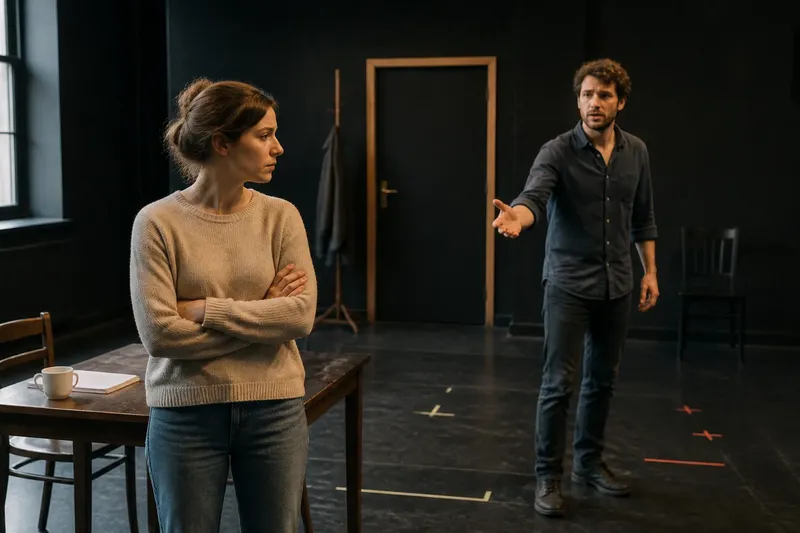
At rehearsal, two actors stand side by side to deliver a tense exchange. The words sound sharp, but the scene feels oddly friendly. When one turns away and the other has to cross the space to meet their gaze, the same lines acquire a different charge. Why a scene changes when actors change their positions is often a matter of who can approach, who must wait and where the audience is invited to look.
Blocking is not decoration added after the acting. Position and movement can show a relationship before either performer speaks: closeness might suggest ease or pressure; distance might signal refusal, caution or simple practicality. Those meanings depend on the moment, so treat them as questions to explore rather than fixed rules. If a scene feels muddy, test its shape before reaching for extra dialogue.
Why does a clear exchange still feel confusing?
Often, the performers’ positions are working against the scene’s central relationship. Two characters may be arguing about trust while standing comfortably together, or a character who controls the conversation may be placed at the edge, with no visible connection to the person they are addressing. The audience can follow every sentence and still struggle to read the dynamic.
Start by naming the change in the scene, not its general mood. Does one person gain the other’s attention? Does an invitation become a demand? Does a character retreat from a decision? A precise change gives the actors something playable. “Make it more tense” is broad; “one person is trying to keep the other from leaving” suggests choices about distance, orientation and movement.
Then look at the positions already in use. Ask who is nearest the exit, who has to turn to see whom, and whether either actor can move freely. These details do not dictate an interpretation, but they expose the physical facts the scene is giving the audience.
What if both actors seem equally in control?
When the scene is meant to shift in power but both performers remain in a balanced arrangement, the change may have no visible shape. They might stand at equal distances, face each other squarely and remain rooted through the exchange. That can be useful for a formal confrontation, but it may flatten a scene whose balance is supposed to tilt.
Try changing one relationship at a time. Let the character who is losing ground move first, or have the other claim the space between them. Alternatively, make the more powerful character stay still while the other has to adjust. The movement need not be large. A small turn of the shoulders or a step that closes a gap may carry more meaning than crossing the whole room.
After each version, ask the actors what changed in their attention and what they felt compelled to do. Avoid telling them that a particular position “means” defeat or confidence. The useful question is whether the new arrangement makes the intended shift easier to perceive and more active for the performers.
How can movement clarify who has the audience’s attention?
A scene can lose focus when several things ask to be watched at once. One actor may be delivering an important line while another crosses behind them, handles an imaginary object or reacts with a large gesture. The audience’s eye follows movement, not necessarily the person speaking, so a busy stage can blur an otherwise clear moment.
Identify the instant that matters most: perhaps a character notices a lie, decides to stay or hears an answer they did not expect. Try keeping the other performers still or letting them settle into a clear position during that beat. Their stillness can give the audience room to notice the speaker’s face, while a deliberate movement afterwards can mark the consequence.
For a group scene, arrange bodies so the important relationship is legible from the audience’s likely viewpoint. A tight cluster may hide a speaker; a shallow arc can allow faces to remain visible without making everyone look at the audience. If the room has an awkward pillar or a narrow playing area, adapt the shape rather than asking actors to perform in a formation that obscures the action.
What if a crossing looks like a random walk?
Movement often feels arbitrary when it has no clear cause or destination. An actor may cross because the blocking says “cross here”, while the character has no reason to leave one position for another. The result can look like pacing inserted to keep the scene lively, even when the words are intimate or still.
Give each movement a task linked to the scene: approach to ask for something, move away to avoid an answer, or turn towards a person who has finally become important. The task should be something the character can pursue, not an instruction to display an emotion. “Get them to listen” gives an actor choices; “look angry while moving downstage” mostly supplies a pose.
If the reason is unclear, remove the crossing and play the scene without it. Then restore the movement only if it helps the character’s action or changes what the other person can do. This is a useful place to be strict: extra walking is not automatically more expressive.
How can a scene change when actors change their positions?
Use a simple comparison that keeps the text constant. Mark a starting arrangement with masking tape or spare paper, then play the scene once without planned movement. Try it again with one deliberate change in distance or orientation. A third version can add a crossing at the moment the relationship shifts. Keep the dialogue, pace and basic acting intentions as similar as possible, so you can notice what the spatial change contributes.
Say a community-theatre scene has one character asking another to stay after a meeting. In the first version, they begin beside each other and remain there; the request may feel casual. In an invented alternative, the asker stays by the doorway while the other stands deeper in the room, then the asker steps aside rather than blocking the exit. The observable result to look for is whether the invitation reads as more open, more hesitant or simply easier to follow—not whether one arrangement is automatically correct.
After each run, ask an observer to describe who seemed to seek contact, who avoided it and when the focus shifted. Invite the actors to report what felt possible from each position. If their accounts and the observer’s account differ, that is useful information: perhaps the arrangement reads differently from the seats than it feels onstage. Adjust one feature, then play the moment again.
What questions help diagnose a scene’s shape?
How close should actors stand in a scene?
Choose a distance that supports the action and remains comfortable for the performers, rather than applying a universal rule. A closer position may intensify a private exchange, while more space can make an approach or refusal visible.
Should actors face the audience while speaking?
Not constantly. A slight angle can keep faces and voices available to the audience while allowing actors to address each other naturally; test the view from the actual seating area.
How do you make a stage picture clearer?
Reduce competing movement, separate important relationships where needed and check whether key faces can be seen. Ask an observer to say what drew their eye before explaining what they were meant to notice.
Can blocking change the meaning of a line?
Yes: the same line can feel like an offer, challenge or evasion depending on who approaches, turns away or holds their ground. Keep the wording unchanged while testing the physical choices, so the difference stays legible.
When does a clever arrangement get in the way?
A striking stage picture is not useful if it asks actors to twist awkwardly, hides faces or forces movement that contradicts the scene. Nor does every beat need a fresh position. Some exchanges gain force from staying still, especially when a small shift has already changed who is waiting on whom.
For practical decisions about sightlines, room layout or any venue-specific restriction, follow the venue’s requirements and ask the relevant organiser where needed. Within those limits, keep the rehearsal test modest: preserve the words, alter one physical relationship and notice what becomes clearer or more confusing.
When you next ask why a scene changes when actors change their positions, look for the action that space makes possible. A step can offer contact, expose hesitation or give someone room to refuse. Keep the movement that sharpens that choice; let the rest of the stage breathe.