Reading a Full Script or Starting with Scenes?
Compare reading a full script with starting scene by scene to help your amateur theatre group choose an opening that suits the play and its readers.
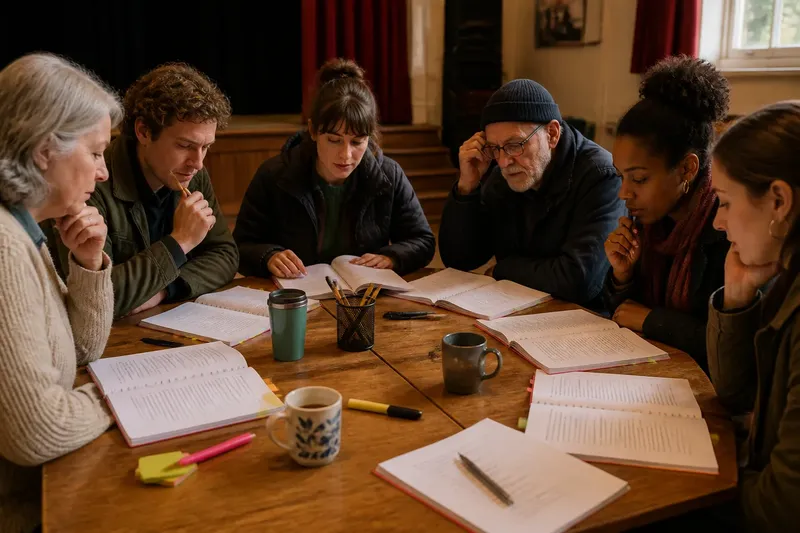
The script is open on a school hall table, and the cast has arrived with coats still on. Do you read the play from the first page to the last, or begin with a few scenes? For an amateur theatre group, reading a full script or starting with scenes shapes what everyone notices first: the whole play’s journey, or the close-up work of a particular moment.
What does a full-script reading reveal?
A continuous read gives the group the play’s architecture. Entrances and exits, recurring images, shifts in pace and the weight of the ending become easier to hear when scenes remain in sequence. A line that seems incidental early on may gather force later; an apparently small role may turn out to hold a hinge in the story.
It also lets readers experience the play as an audience might: without stopping to solve every line. That first pass can expose practical questions. Does the cast list fit the people available? Are there long stretches with no clear change of direction? Does the ending feel earned by what came before?
Keep the first reading light. Assign parts in advance if the cast is large, or let readers swap roles at act breaks if the group is small. One person can read stage directions, but need not perform them. The aim is to hear the shape, not to stage every sound and gesture around the table.
What can scene-by-scene reading uncover?
Starting with selected scenes makes room for detail. Readers can pause over a difficult exchange, compare the characters’ aims, and notice where a scene turns. It suits a group deciding whether a script is playable with its available cast, or a director choosing between several possible pieces.
Scenes can also be read out of order when a particular question matters. A group might compare two scenes featuring the same character to hear how their language changes, or read a crowded scene to see whether the dialogue gives each speaker a distinct voice. This is close listening, not a shortcut to judging the entire play.
The trade-off is context. A scene lifted from its neighbours may seem slower, stranger or more confusing than it does in sequence. Before drawing conclusions, give readers a brief account of what has just happened and what each character wants in the moment. Keep that framing factual; don’t explain away every ambiguity.
When should you choose each approach?
Choose a full-script reading when the main question is whether the play holds together: its story, scale, roles and overall tone. It is particularly useful when the group has not yet settled on a script or needs to understand the complete arc before discussing rehearsal priorities.
Choose scene-first reading when the group needs to inspect a particular challenge: a difficult relationship, a dense section of dialogue, or the demands of a scene with several speakers. It can also help when time is limited and the group is considering an extract rather than committing to the whole play. Be clear that a few scenes can suggest suitability, but cannot tell the group everything about the work.
For many groups, the choice is not permanent. A brisk full read can establish the map, followed later by focused readings of scenes that prompt questions. Alternatively, a short scene session can help a group decide whether it wants to make time for the complete script. Keep each session’s purpose visible, so a close reading does not quietly become a verdict on the whole play.
Which reading questions help most?
Should everyone read a different role?
Different readers can make voices easier to distinguish, especially in a large group. If the cast is small, swapping parts between scenes can help people hear the writing rather than settle too quickly on one actor’s interpretation.
Is it useful to stop and discuss every scene?
Not on the first pass through a whole script: frequent pauses can break its rhythm and obscure the larger pattern. In a scene-focused session, pauses are more useful when they serve a specific question, such as where a character changes their mind.
What if the play contains unfamiliar references?
Mark them and continue unless the reference blocks basic understanding. Afterwards, check the script’s notes or ask what context the group needs; avoid turning a first reading into a long research detour.
Can a scene reading tell us whether a play is right for our group?
It can reveal whether the language and immediate roles interest the readers. It cannot show how every character develops or how the ending lands, so read the whole play before making a final choice about producing it.
How can you keep the notes useful?
Give readers a simple way to record observations without turning the session into a review panel. A sheet beside the script might have three prompts: “What changed?”, “What needs context?” and “What should we hear again?” Ask people to note page numbers and concrete moments, not broad verdicts such as “confusing” or “slow”.
- Mark a moment where the story’s direction shifts.
- Note a role whose importance becomes clearer later.
- Circle a line or reference that needs context.
- Record a practical question about cast size or doubling.
- Flag a scene the group wants to revisit, and state why.
Say a community group is choosing between two scripts and can gather for only one short session before selecting a candidate. It might read an opening scene and a later turning point from each play, noting cast demands and what context the extracts need. The expected observable result is a sharper comparison of those particular features; the group should still read its preferred script in full before deciding whether its complete arc suits the project.
What is not worth doing at the first read?
Don’t spend the session polishing accents, blocking imaginary furniture or debating the one “correct” emotional reading. Those choices can distract from the text’s larger signals, and they may close down possibilities before the group has understood the scene. A quick note is enough when a line catches the ear; there will be time to return to it if it matters.
The useful distinction is simple: a full read shows how the parts connect, while scene-first reading lets the group examine a chosen part closely. For reading a full script or starting with scenes, choose according to the question in front of you, then make the next session answer what that first approach could not.