The Prop Table Is Not a Storage Shelf
A prop table organised by use keeps handovers clear, helps performers find the right object and makes a small theatre production easier to run.
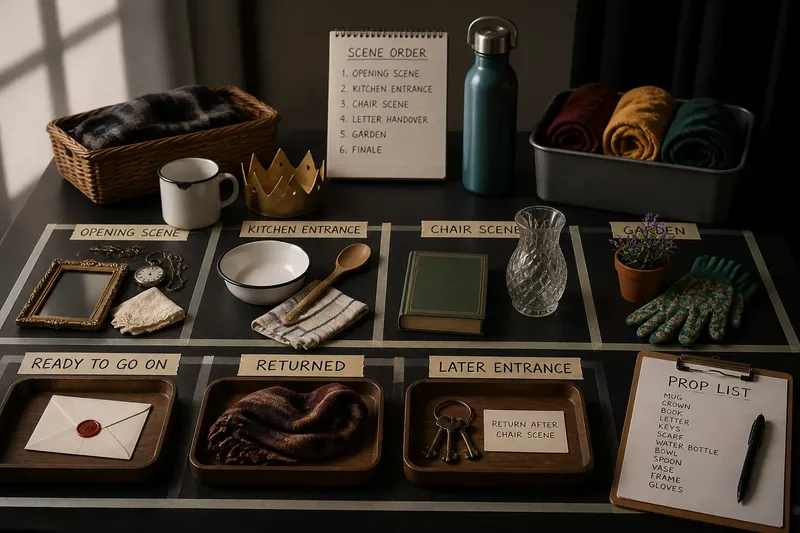
At the end of rehearsal, a chipped mug lands beside a paper crown, a set of keys and somebody’s water bottle. By the next run-through, the mug has vanished beneath a scarf. A well-organised prop table is not a tidy-up project: it is a map of how objects enter the performance, move between hands and leave the stage.
For a school play or community production, the right arrangement depends on the show’s traffic. Grouping props by use—rather than by owner, material or who brought them in—makes the table easier to read under pressure. Three approaches are useful: group by scene, by performer or by handover. You can choose one as the main system and borrow a feature from another when the production needs it.
Why organise the prop table by use?
A prop table serves people who may have only a brief moment to collect or return an object. The performer needs to recognise what they need; the person helping backstage needs to see whether it is in its place. A clear arrangement supports both without turning the table into a puzzle.
Begin by listing the objects that appear in the performance and noting when each is needed. Distinguish hand props—items carried or handled by performers—from set dressing, which belongs in the stage environment. A vase that sits on a shelf throughout a scene may not need a place among objects collected for entrances, even if it is being managed by the same team.
Use plain labels such as “opening scene” or “kitchen entrance”, rather than a private shorthand only one person understands. Masking tape and a marker are often enough. Keep labels visible and leave room for hands to put things back; a carefully labelled square is little help if it is hidden under a pile.
Would grouping by scene suit your show?
Scene grouping works well when the cast changes location or the same performer carries several objects in a particular section. Set out one area for each scene or sequence, with related props together. A handwritten scene list can sit at the table’s edge so someone can check the order without asking the stage manager to translate.
This arrangement is especially useful for a short play with distinct episodes, a class performance with several groups, or a production whose props are collected in batches before each scene. It gives a quick answer to “What do we need next?” without requiring the user to know who owns each object.
It is less suitable when a prop travels across many scenes. A book used throughout the play could appear to belong in several places, creating duplicates or uncertainty. Give that object one clearly marked home and note its next destination on a small card, rather than placing copies of the same instruction around the table.
When is performer grouping the clearer choice?
Grouping by performer helps when a small cast carries its own props and has a predictable place to collect them. Each person gets a labelled tray, basket or section of table, with the relevant objects kept together. This can suit a classroom production where actors are responsible for their own entries and the backstage team is small.
The benefit is personal clarity: a performer can check one place before going on. The weakness is that the arrangement may obscure the order of a scene. If several people need objects at the same moment, each may reach across the table at once; a performer-based layout can also become confusing when roles double or a prop passes to another actor.
Keep performer grouping only if the labels match the cast’s working names and remain useful through role changes. If actors share objects, mark the transfer plainly or give the item a separate handover position. The object’s route matters more than the name of the person who first brought it in.
Does a handover layout fit the action?
For productions with frequent exchanges, organise around the prop’s journey. Put items waiting to go on in one clearly marked area, returned items in another, and objects awaiting a later entrance in a third. The exact zones should match the traffic backstage; do not add compartments merely because the table has spare space.
This approach suits a fast-moving farce, a scene with repeated exchanges, or a show where a helper passes objects to performers. It makes status visible: ready, returned or still in use. It is less helpful when objects are used only once and the team would spend more effort moving them between zones than locating them.
Say a community group has a letter passed from one character to another, then placed on a chair before the next scene. Imagine the team marks a single handover spot beside the scene group and puts a card there reading “return after chair scene”. The expected visible result is a clear gap in the letter’s route: it is not mistaken for an unused prop, and the next person can see where it belongs.
Which prop-table approach should you choose?
These are not competing rules so much as different answers to different kinds of traffic. Choose the arrangement that resolves the most common question backstage:
- Choose scene grouping when objects are collected in clear batches and the scene order is the easiest reference.
- Choose performer grouping when individuals carry distinct sets of props and roles stay easy to identify.
- Choose handover grouping when objects move between people or need to be returned at a particular point.
- Combine approaches sparingly when one shared prop needs a handover marker inside an otherwise scene-based layout.
To decide, walk through the performance with the current prop list. For each object, ask who needs it, when it is collected, and where it goes afterwards. If a question has no obvious answer, that is a sign to make its route visible—not to add another general storage box.
What should the team agree before the next run?
Should props be returned to their labelled place?
Yes: agree that a return means putting an object back in its marked spot, not simply setting it somewhere on the table. A consistent home lets the next person check the layout at a glance.
How should a substitute find the right object?
Use labels based on scenes, roles or actions that appear in the script, and avoid abbreviations that need explanation. Keep the list of props beside the table so a new helper can match an item to its use.
What if an object is missing?
Leave its marked space visible and tell the person coordinating props, rather than shifting other items to disguise the gap. That makes the absence easier to spot and follow up before the next entrance.
Do you need a detailed diagram?
Only if the table has several distinct zones or the layout is difficult to remember. For a simple setup, visible labels and a short prop list are easier to maintain than a diagram no one checks.
What is not worth the effort?
Colour-coding every object, buying matching containers or making an elaborate map can consume time without clarifying what happens next. A marker, tape and a layout the company can explain in one sentence are often enough. Follow any relevant manufacturer instructions for fragile or specialist objects, and ask a qualified professional where handling raises a safety concern.
A prop table earns its space when it tells the next person what an object is doing in the show. Choose a system that follows the performance’s traffic, then keep the labels and return habits consistent. If an item has no obvious home, treat that as useful information: its route still needs to be agreed.